
Clinton County Court Records After a Jail Arrest
After a Clinton County jail arrest, the booking record and the court case record are separate. The jail, VINE, and MobilePatrol custody route answers whether someone is held at Clinton County Jail and whether custody notifications are available. The court route answers what charges were filed, what court is handling the case, which appearances are scheduled, what bail or release conditions were imposed, and what disposition was entered.
The Clinton County District Attorney's Office prosecutes misdemeanor and felony cases in 13 town and village courts as well as Plattsburgh City Court. Felony-level cases are prosecuted and disposed of in County Court. For the custody side, use jail inmate records. For booking-photo limits and requests, use jail roster mugshots. Court records after an arrest are about the filed criminal case, not a mugshot gallery.
The District Attorney page identifies the local prosecutor and office role. Source: Clinton County District Attorney.
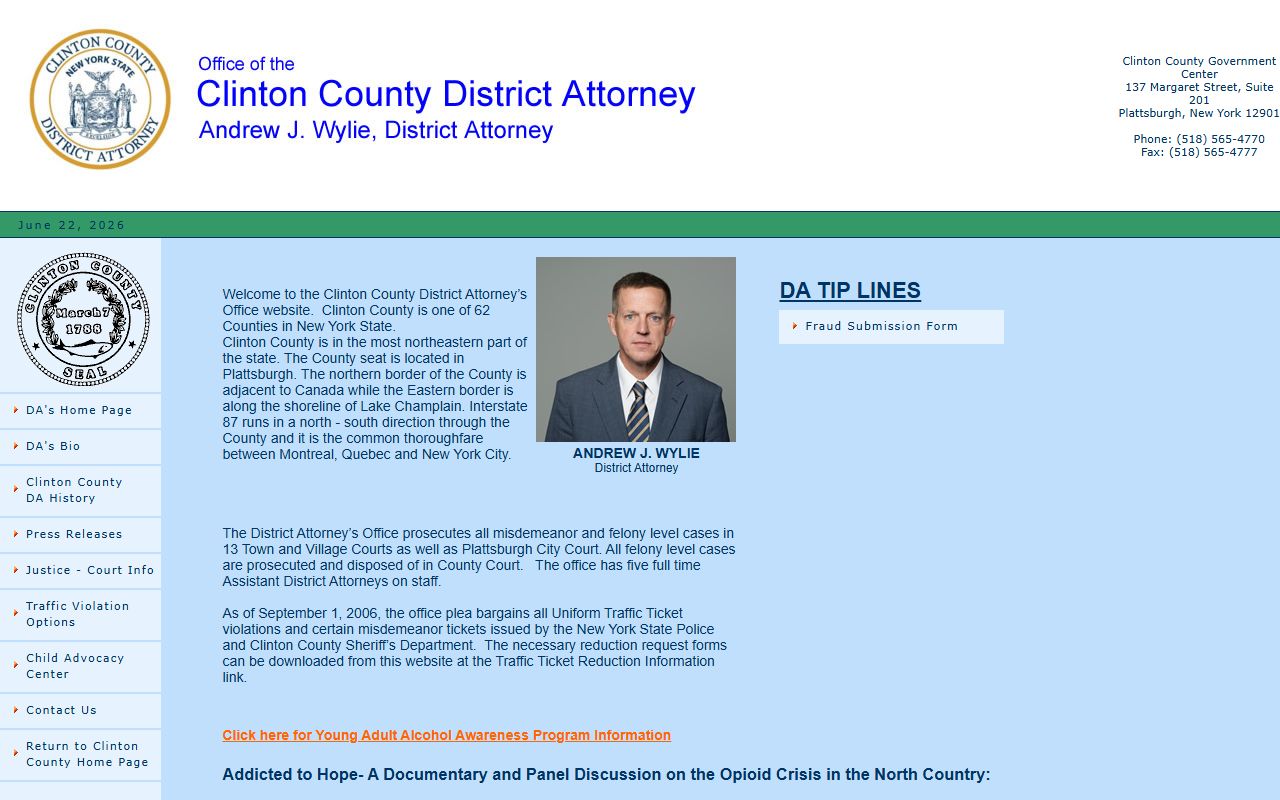
The DA information matters because the prosecutor's charging decisions can change what appears in the court record after the initial jail booking.
How to Find Clinton County Court Records After an Arrest
Start with the arrest and booking details, then move to the court record. A booking number, arrest date, defendant name, date of birth, arresting agency, and court or judge from bail paperwork can help match a jail event to the correct case. New York's WebCriminal/WebCrims system can provide criminal case information with future appearance dates in selected courts, but coverage and public display vary by court, so clerk contact remains important.
- Confirm the person was booked through Clinton County custody channels, including VINE, MobilePatrol, or the jail at 518-565-4343.
- Search New York WebCriminal by defendant name or case identifier when a public case-search path is available.
- Check the court named on arraignment or bail paperwork. Misdemeanor and violation matters may begin in town, village, or Plattsburgh City Court; felony matters may move to County Court.
- Read the charge list for code, level, count, next appearance, warrant status, bail or release condition, and disposition.
- Contact the proper clerk if the online search does not show the case. Supreme and County Court Chief Clerk Denise Durkin can be reached through the court number listed in county research, 518-536-3840.
- Use the New York Courts Criminal History Record Search, or CHRS, for a certified statewide court search when appropriate. NY Courts lists CHRS at $95.00 per search.
New York Courts explains several case-record channels, including eCourts, CHRS, clerk requests, FOIL for administrative records, and NYSCEF guest search where applicable. Source: New York Courts case records help.
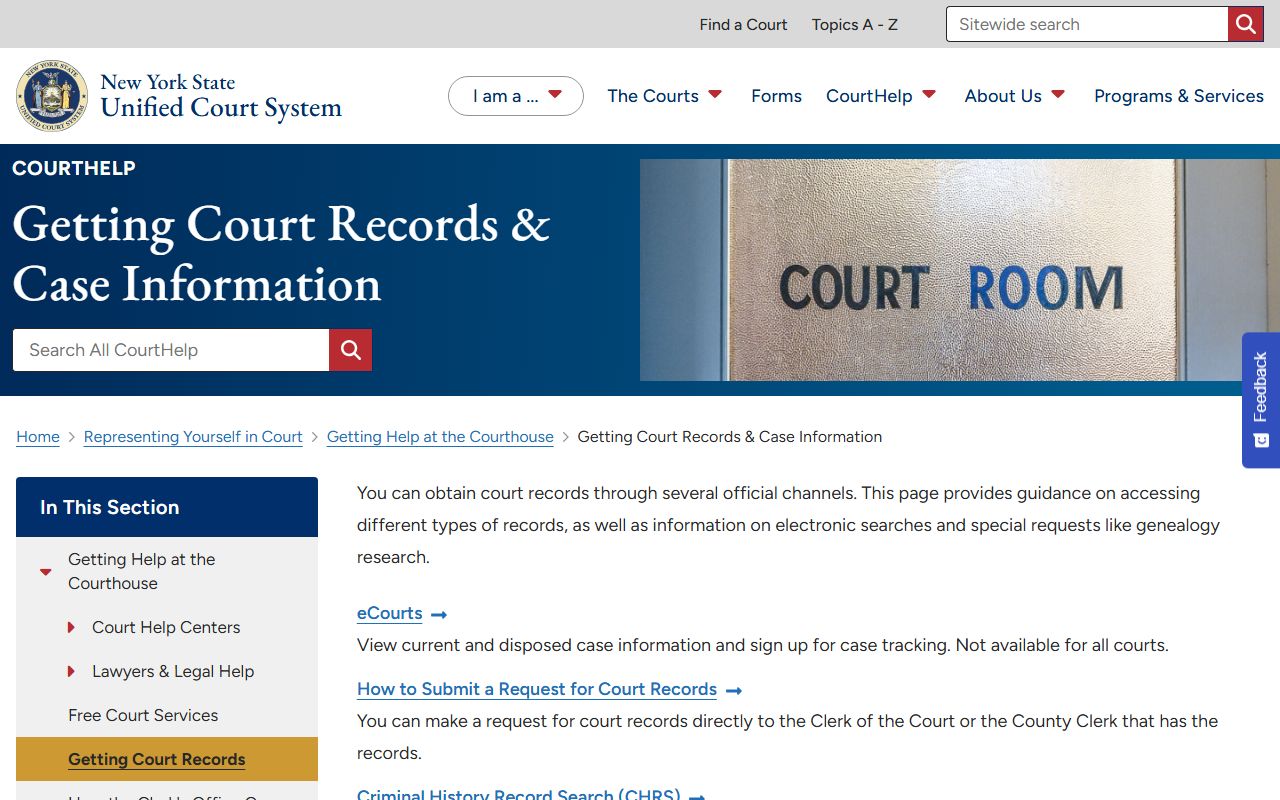
Use court channels for charges and dispositions instead of relying on jail custody text as the final legal record.
WebCriminal Court Records Search Fields After an Arrest
WebCriminal is a court-search path, not a Clinton County jail roster. Automated inspection could not safely confirm every result field, so the table reflects the public search controls documented in the research rather than a promised result layout.
| Field or Control | Type | Required | Options or Notes |
|---|---|---|---|
| Case Search | Tab or menu | Yes | Entry points include Case Identifier, Defendant, and Court Calendar. |
| Case Identifier | Search path | Optional | Use docket, case, summons, or other identifier when known. |
| Defendant | Search path | Optional | Use the defendant's name; match carefully against date of birth or case context when available. |
| Court Calendar | Search path | Optional | Use when looking for upcoming appearances by court and date. |
| County | Dropdown or filter | Optional | Availability varies; use clerk fallback if Clinton County court data is not exposed. |
| Reset | Button | No | Clears court search filters on UCS search pages. |
How Court Charges Get Filed After an Arrest
Jail booking charges can be initial arrest or holding charges. The court record after arrest begins with an accusatory instrument or later superior-court filing. In New York, criminal cases can involve a complaint, information, simplified information, prosecutor's information, felony complaint, indictment, or superior-court information. The key point for Clinton County searches is that a roster charge is not the same as a final conviction and may not match the DA's final filed charge.
| Document | Who Uses or Files It | Common Role After Arrest | What to Check |
|---|---|---|---|
| Complaint | Officer or prosecutor | Starts many local criminal court matters and supports arraignment. | Original factual allegations, charge level, court, and date filed. |
| Information or prosecutor's information | Prosecutor or local court process | Can replace or refine the original accusatory instrument. | Whether charges were amended, reduced, added, or superseded. |
| Indictment or superior-court information | Grand jury or superior-court felony process | Moves felony prosecution into County Court or records the superior-court charge. | Counts, felony class, arraignment in County Court, and disposition. |
Charge Status in Court Records After an Arrest
Charges can change as the District Attorney reviews evidence, negotiates a plea, presents a felony matter, or dismisses unsupported counts. A person may be booked on one charge, arraigned on another, and convicted of a reduced offense. Always read each count separately.
| Status | What It Means |
|---|---|
| Pending | The charge remains open and has not reached final disposition. |
| Amended or reduced | The filed charge changed, often through prosecutor review, plea negotiation, or court action. |
| Added or superseded | A later filing added counts or replaced an earlier accusatory instrument. |
| Dismissed | The court ended that charge without a conviction on that count. |
| Convicted by plea or verdict | The case ended in a guilty plea or finding after trial for that count or a reduced count. |
| Sealed | Public access is restricted by statute or court order, often after favorable termination or eligible disposition. |
| Warrant or bench warrant | The case may show an outstanding court order tied to missed appearance or another violation. |
Bail and Release Conditions After an Arrest
Bail and release conditions sit at the intersection of jail records and court records. Clinton County's online bail instructions require defendant name, date of birth, booking number, court or judge, and cash bail amount. If the booking number is unknown, the county says to call the booking office at 518-565-4351. New York bail law is in Criminal Procedure Law Article 500, and CPL 500.10 defines bail, cash bail, bail bond, recognizance, and related terms.
| Release Term | How It Works |
|---|---|
| Recognizance | The person is released on a promise to return to court without posting money. |
| Non-monetary conditions | The court orders conditions that do not require cash, such as reporting or conduct rules. |
| Cash bail | Money is posted in the amount fixed by court order; Clinton County remote payments go through GovPayNet. |
| Bail bond | A written undertaking by obligors to ensure future court appearance. |
| Remand or no-release hold | The court orders custody without release, or another warrant, parole, federal, ICE, or agency hold blocks release. |
Clinton County warns that remote bail funds paid by credit card become the defendant's property, the receipt or bail affidavit is made in the defendant's name, and any court refund goes to the defendant rather than the cardholder. Confirm release eligibility before paying because a warrant, detainer, parole matter, federal custody, ICE custody, state-ready status, or remand order can keep someone in jail even when money is posted.
Warrants, MobilePatrol, and Court Records After Arrest
No official Clinton County browser-based active warrant table was found on the county website. The sheriff-advertised MobilePatrol app is the located warrant channel because app materials describe real-time warrants, including child support warrants, and crime-tip features connected to warrant listings. A warrant arrest can create a Clinton County Jail booking, and the later court record may show bench-warrant status, appearance status, bail changes, or a hold.
For a warrant tied to a pending case, contact the issuing court or counsel. For general routing, the sheriff's main number is 518-565-4300. Do not treat an app listing or unofficial search result as legal advice. Surrendering at a sheriff's office can result in arrest, which may be appropriate, but the person should understand the risk and contact an attorney when possible.
Charges vs. Convictions in Court Records
An arrest charge is an accusation or holding reason. A conviction is a final outcome by guilty plea or verdict. Court records after a jail arrest may list both dismissed charges and convicted counts, so read the status column rather than assuming every listed charge became a conviction.
| Charge | Conviction | |
|---|---|---|
| Stage | Accusation filed or reviewed after arrest. | Final result after plea or verdict. |
| Proof level | Begins from probable cause or a filed accusatory instrument. | Requires guilty plea or proof beyond a reasonable doubt at trial. |
| Can change | Can be amended, reduced, added, superseded, or dismissed. | Can be appealed, vacated, sealed, or otherwise affected by later court order. |
| How to verify | Check WebCriminal, clerk records, arraignment papers, and DA filings. | Check final disposition, sentence, certificate, or certified court record. |
Sealed vs. Expunged Arrest and Court Records
New York often uses sealing rather than broad public expungement. Criminal Procedure Law 160.50 governs sealing when a criminal action terminates in favor of the accused. Public Officers Law 87 and 89 also allow agencies to deny or redact records for privacy, law-enforcement, statutory, or other reasons. Juvenile, youthful offender, sealed, and some dismissed matters may not appear in ordinary public searches.
| Sealed | Expunged | |
|---|---|---|
| Public visibility | Hidden from ordinary public access by law or court order. | Destroyed or treated as if it did not exist where an expungement statute applies. |
| New York criminal cases | Common access-limiting term for favorable termination and eligible dispositions. | Less common than sealing; do not assume a New York arrest disappears from every government system. |
| Law enforcement access | May remain available to limited criminal justice users under statutory rules. | Very limited where true expungement applies, but details depend on the law. |
| How to verify | Use the court clerk, certified disposition, or sealing order. | Use the specific expungement order or statute, if one exists. |
DA and Clerk Roles in Court Records After Arrest
The District Attorney decides how to prosecute the case, assigns assistant district attorneys, presents or resolves felony matters, plea-bargains eligible tickets and misdemeanors, and works with specialty areas such as domestic violence, drug cases, DWI, Drug Court, Mental Health Court, prison cases, and child sex abuse. The DA does not act as a public case-clerk service and does not give legal advice to defendants.
The clerk side is different. The Clinton County Clerk, Brandi B. Lloyd, is at 137 Margaret Street, first floor, Plattsburgh, and the office assists Supreme and County Courts by handling fees, fines, filings, and certified court records. The County Clerk phone is 518-565-4700, and regular office hours are Monday through Friday, 8:00 AM to 4:00 PM. Supreme and County Court clerk routing uses the court office at 518-536-3840.
The County Clerk page shows the court-record and filing role. Source: Clinton County Clerk.
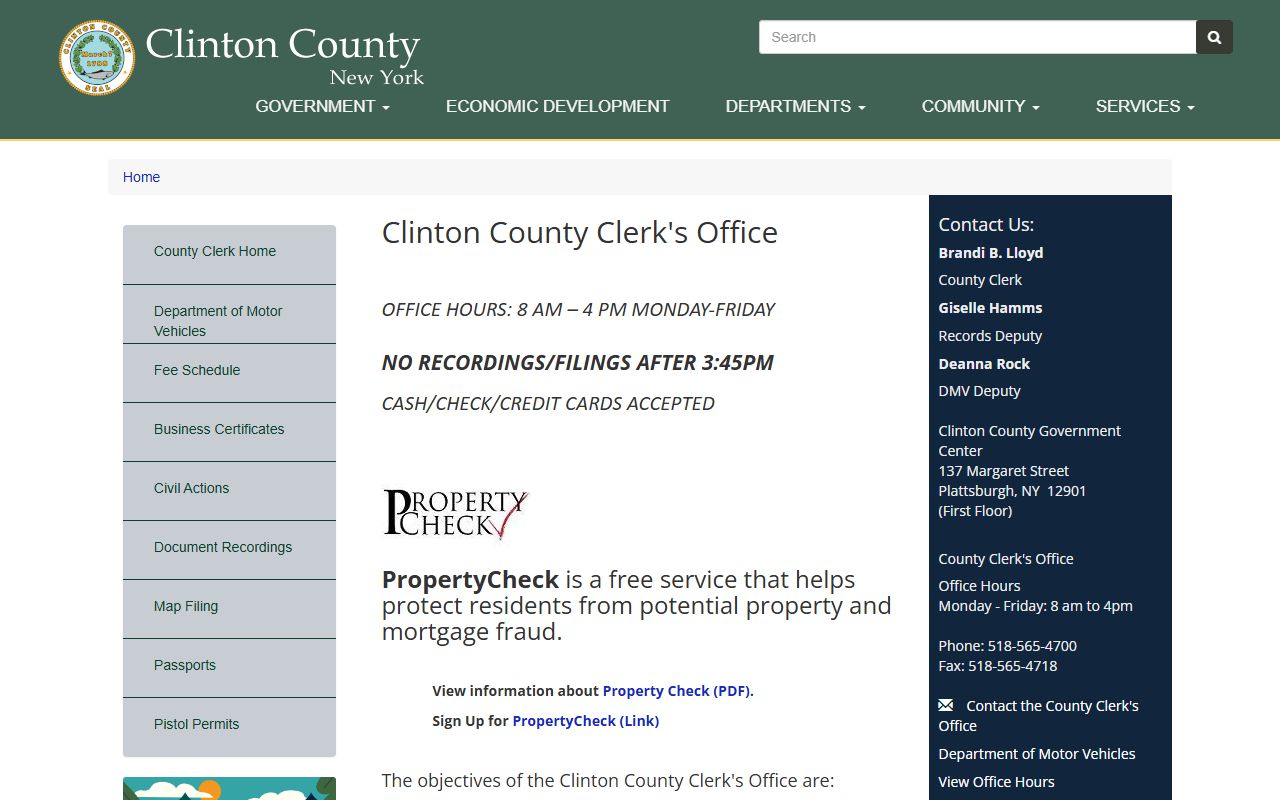
Use the clerk for copies, certifications, and court-file routing; use the prosecutor's office for public information that office actually publishes about prosecution.
Background Check Limits for Court Records After an Arrest
Casual court-record searches and certified background searches serve different purposes. NY Courts CHRS is a statewide court-system search and costs $95.00 per search. It is not the same as a live jail roster, VINE custody notification, MobilePatrol booking list, or a full fingerprint-based DCJS RAP sheet. For employment, tenant screening, credit, insurance, or other regulated screening, use an FCRA-compliant process and proper authorization.
Important: This website is not a consumer reporting agency and cannot be used for employment, housing, credit, insurance, or other FCRA-covered screening.
Restricted Court Records After an Arrest in Clinton County
Some court records after an arrest are not public. Juvenile matters, youthful offender records, sealed cases, certain dismissed charges, records protected by court order, and materials tied to an active investigation may be withheld or redacted. FOIL can help with sheriff administrative records, jail records, incident reports, and some agency materials, but court case records usually follow court and clerk access rules rather than the sheriff's FOIL process. For a court disposition, certified copy, or sealing question, contact the court or clerk that holds the case.